The short answer
Most healthy adults reach light ketosis (blood ketones of 0.5 mmol/L or higher) somewhere between 24 and 48 hours into a fast, and deeper ketosis by day 3. But it isn't a fixed clock: in one hospital group, about one in four people hadn't reached high ketone levels even after 72 hours. Timing depends on what you ate before, how active you are and how much stored sugar your liver is holding.
It's a dial, not a light switch
The internet loves a clean number. "Ketosis in 12 hours." "Fat-burning mode by morning." The truth is less tidy and more interesting.
Your body is always burning a mix of fuels. Ketosis isn't a moment where a switch flips from sugar to fat. It's a gradual shift, where fat and ketones take over a bigger share of the work each hour you go without food. Over three days, that shift is significant.
The ketosis timeline: hour by hour over 3 days
Ketones climb slowly on day 1, faster on day 2, and are usually well established by day 3. These are typical ranges for healthy adults; your own numbers may run earlier or later.
| Time since last meal | Typical blood ketones (BHB) | What's happening |
|---|---|---|
| Overnight (about 12 hours) | Around 0.1 mmol/L | Running on sugar stored in the liver |
| 24 hours | Rising, often 0.3–0.6 mmol/L | Liver sugar stores running low; fat use rising |
| 48 hours | Often 1–2 mmol/L | Light to moderate ketosis for most people |
| 72 hours | Often 2–3 mmol/L | Ketones are a major fuel for muscles and the brain |
Day 1: burning through stored sugar
For the first 12 to 24 hours, your body leans mainly on glycogen, the sugar stored in your liver and muscles. Fat burning is already rising, but ketones stay low because the liver still has sugar to give. In one small study of healthy volunteers, blood ketones were just 0.1 mmol/L after a 12-hour fast.
Day 2: the real shift
As liver glycogen runs low, insulin falls further and fat is broken down faster (here's what happens to insulin over 3 days). The liver turns a share of those fatty acids into ketones, mainly one called beta-hydroxybutyrate (BHB). This is when most people cross the 0.5 mmol/L line that defines nutritional ketosis.
Day 3: ketones carry real weight
In that same study, ketones averaged 2.3 mmol/L at 72 hours, roughly 20 times higher than after an overnight fast. By now ketones supply a meaningful share of the brain's energy. Glucose still matters: the brain keeps using some sugar, which the liver makes on its own. In route terms, day 3 is the summit.
Not everyone gets there at the same speed
Hospitals use 72-hour fasts to test for rare blood sugar disorders, so there's good data on how ketones behave in ordinary people. In one UK hospital group without the disorder, about three in four reached a high ketone level (2.7 mmol/L) during the fast, at a median of about 50 hours. The rest got there more slowly or not at all within 72 hours. Same fast, very different timelines.
What makes ketosis come faster or slower?
The biggest factor is how much stored sugar you start with. Anything that lowers it before or during the fast tends to bring ketosis forward:
- What you ate the day before. A big pasta dinner or a heavy holiday meal tops up glycogen and can delay ketosis. A lower-carb last meal usually speeds it up; see how to prepare for a 3-day fast.
- Movement. A walk or light workout on day 1 uses up muscle glycogen faster. Well established in exercise research.
- Your usual diet. People who already eat low-carb are often in ketosis sooner.
- Body size and muscle mass. Larger bodies tend to store more glycogen, which can take longer to burn through.
- Sex. Some research suggests women's ketone levels rise faster during fasting than men's, but the evidence is limited.
Does Burnbox's bone broth slow ketosis?
Possibly a little. Each Burnbox day includes an evening chicken bone broth with 3 g of protein, plus fiber shakes, for about 100 calories in total. Protein can trigger a small insulin response, which may keep ketone levels slightly lower than on a strict water fast. We think that's worth it: a small amount of support helps far more people actually finish three days, and finishing is what moves the needle.
How to tell if you're in ketosis
The only reliable way is to measure. How you feel is a clue, not proof.
| Method | Accuracy | Notes |
|---|---|---|
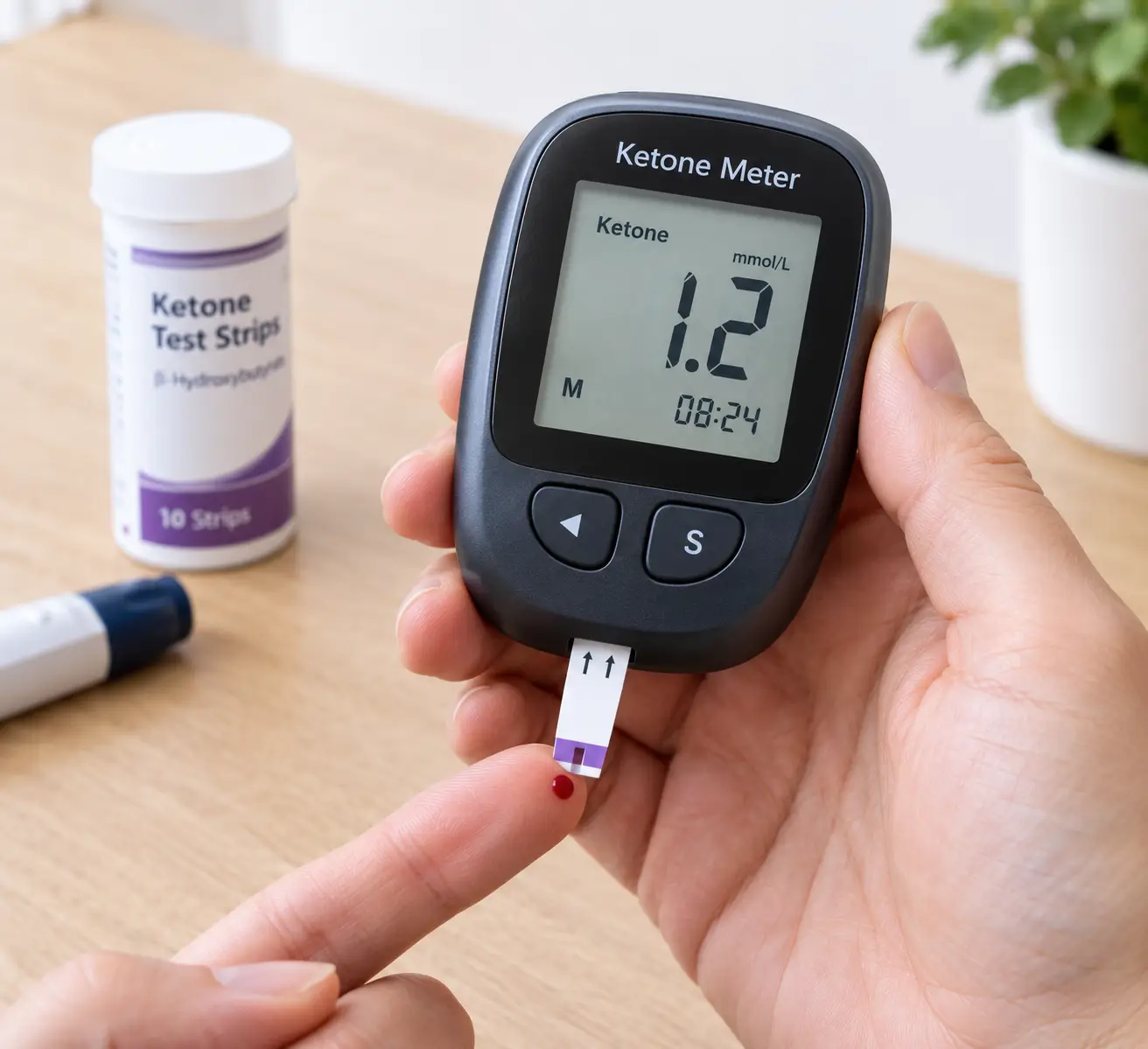
| Blood ketone meter | Most accurate | Finger-prick, like a glucose meter; measures BHB directly |
| Breath ketone meter | Moderate | Measures acetone; no needles; readings vary by device |
| Urine strips | Low after the first days | Cheap and fine for a yes/no early on; less reliable as the body adapts |
Common signs people notice include less hunger by day 2 or 3, a metallic or fruity taste in the mouth, and steadier energy. These are reported experiences, not tests.
Three ketosis myths worth dropping
- "Ketosis means you're burning pure fat." You burn fat all the time, especially overnight. Ketosis means fat has become a much bigger share of your fuel, not the only one.
- "Keto flu is your body detoxing." There's no good evidence for that. Headaches, tiredness and dizziness in the first days often come from losing sodium and water as insulin falls, and electrolytes usually help. More in why electrolytes matter during a fast.
- "Higher ketones mean more fat loss." Not necessarily. A higher ketone number shows how much fuel your liver is making, not how much fat you've lost. For realistic numbers, see how much weight you can lose in 3 days.
How sure can we be?
Established: fasting raises blood ketones over 1 to 3 days, and BHB of 0.5 mmol/L or more defines nutritional ketosis.
Established, from small studies: typical levels of about 2 to 3 mmol/L by 72 hours, with wide differences between people.
Emerging: that women reach ketosis faster than men.
Not shown: that higher ketone numbers mean more fat loss, or that ketosis "detoxes" anything.
Ketosis vs ketoacidosis: not the same thing
Nutritional ketosis from fasting usually keeps ketones below about 3 to 5 mmol/L, and your body keeps its blood chemistry balanced. Diabetic ketoacidosis (DKA) is a medical emergency where ketones climb far higher and the blood becomes acidic, usually because there's almost no insulin at all.
In healthy people, a 3-day fast doesn't cause DKA. But some people need medical advice first: anyone with type 1 diabetes, anyone taking insulin, sulfonylureas or SGLT2 inhibitors (like Jardiance or Farxiga), and people who are pregnant, breastfeeding, under 18 or have a history of eating disorders. See who shouldn't do a 3-day fast.
Want three days with a plan?
The Burnbox kit gives you a measured Electrolyte Booster for the day-2 slump, fiber shakes for hunger and an evening bone broth, with one box level per day. See the 3-day kit
FAQ
How long does it take to get into ketosis when fasting?
Most healthy adults reach light ketosis (0.5 mmol/L) within 24 to 48 hours, and higher levels by day 3. Some people take longer.
Can you get into ketosis in 24 hours?
Some people can, especially if they ate low-carb beforehand or exercised. Many people need closer to 36 to 48 hours.
What level of ketones counts as ketosis?
Blood BHB of 0.5 mmol/L or more is the common definition of nutritional ketosis. After a 3-day fast, levels of 2 to 3 mmol/L are typical.
Does ketosis mean I'm losing fat?
It means fat has become a larger part of your fuel. Real fat loss over 3 days is modest; much of the early scale drop is water.
Why do I get a headache when entering ketosis?
Falling insulin makes your kidneys release more sodium and water. Low sodium is a common cause of headaches, tiredness and dizziness, which is why electrolytes matter during a fast.